|
Newsletter #123 for December 2025 |
|
|
|
|
|
|
|
|
|
EPA is resuming their perchlorate rulemaking after a federal court in New York ordered the agency to propose and finalize perchlorate MCLs under the Safe Drinking Water Act (SDWA). Perchlorate is a chemical commonly found in rocket fuel, munitions, fireworks, and even naturally in arid regions. When consumed, it can impair thyroid function, raising concerns for infant and fetal development. Now that the 43-day federal government shutdown is over, EPA and the Natural Resource Defense Council (NRDC) have agreed to postpone the deadline for EPA to release a perchlorate SDWA proposal until January 2nd.
EPA’s goals include establishing a science-based MCL and ensuring the availability of funding through the Drinking Water State Revolving Funds to support remediation efforts and treatment upgrades in systems affected by emerging contaminants like perchlorate. Operators and regulators should prepare for a forthcoming public comment period after the proposal.
To help utilities prepare, Pace Analytical has released an FAQ addressing concerns they expect from their drinking water clients, such as anticipated limits and analytical methods. While the final MCL is pending, experts referenced the 2008 Interim Health Advisory of 15 parts per billion (ppb) as a likely benchmark, making this an ideal time for operators to evaluate their system’s potential infrastructure needs if perchlorate MCL will impact their operations. |
|
|
|
|
|
|
The Water Research Foundation (WRF) has awarded nearly $6 million in funding across 13 new projects through its 2025 Tailored Collaboration (TC) Program, targeting high‑priority One Water research areas. This program enables WRF subscribing utilities to directly participate by sponsoring/funding research ideas. WRF will match subscriber contributions on a one‑to‑one basis, up to $150,000 per project. Utilities can also participate as test facilities, provide water samples, respond to surveys, loan equipment, or share staff expertise on research projects. These utilities will have access to firsthand information on the study and benefit from working with researchers and others in the water community.
Projects selected for 2025 include:
-
Evaluating an Innovative Ion Exchange Process for Co-Treatment of Dissolved Organic Matter and PFAS (5380) - $390,610
-
Machine Learning Meets Disinfection: Full-Scale Wastewater Chloramination Control for Compliance and Cost Savings (5385) - $393,314
-
Integrated Computer Vision Intelligence System for Activated Sludge Microscopy and Process Optimization (5389) - $300,000
|
|
|
|
|
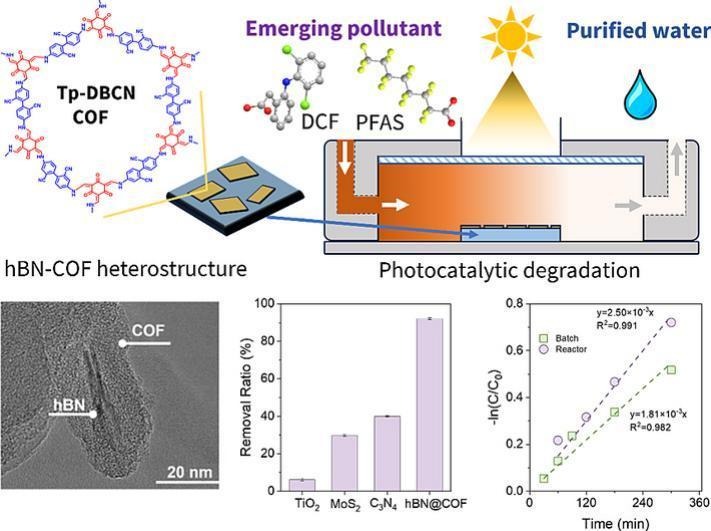
Rice University researchers have engineered a metal-free, light-activated hybrid material that efficiently breaks down a range of industrial pollutants in water, including PFAS. The innovate process combines a covalent organic framework (COF) grown directly on a hexagonal boron nitride (hBN) film using defect engineering, a technique that deliberately embeds defects or imperfections into a material in order to produce new properties or behaviors. When exposed to light, the COF absorbs photons and generates electron–hole pairs, while the hBN layer helps keep these charges separated, which is critical for driving essential chemical reactions.
The electrons produced are highly reducing, while the holes are strongly oxidizing. In PFAS contaminated water, these charges interact with dissolved oxygen and water molecules to form reactive species like hydroxyl radicals (OH) and superoxide anions (O2-). These radicals attack the strong carbon–fluorine bonds in PFAS molecules, reducing them into harmless end products like CO₂ and fluoride ions. This approach avoids using metals and relies on light energy, making it a sustainable and cost-effective approach to treating PFAS. |
|
 |
|
Source |
|
|
|
|
This 6-minute interview features Laurel Schaich, principal environmental engineer at CDM Smith, who covers the benefits and challenges of implementing thermal hydrolysis process (THP) processes and why it’s gaining traction in US utilities as a pre-treatment step before anaerobic digestion. Key topics covered include seeding and startup best practices to prevent digester upset and foaming. Controlling feed rates and monitoring digester health through alkalinity, volatile fatty acids (VFAs), pH, and biogas flow. It also highlights THP’s benefits, which include smaller digester footprints, production of class A biosolids, and increased biogas yield, along with safety considerations for high-pressure, high-temperature systems and cost challenges like reducing digester construction expenses. Real-world examples from utilities in Michigan, Tennessee, and Texas showcase successful implementation strategies. |
|
Upcoming Events
A listing of webinars, symposia, and conferences relevant to this work. |
|
|
|
EPA Tools & Resources Webinar: Lead (Pb) Overview and Data Mapping
January 21, 2026 / Virtual 15:00 - 16:00 Eastern Time Zone
U.S. EPA
This free webinar will demonstrate EPA's new multimedia data mapping blueprint that is designed to help states and partners identify high priority areas with lead exposure, allowing for targeted investments to improve public health. |
|
|
|
Membrane Technology Conference
February 2-5, 2026 / Myrtle Beach, SC
American Water Works Association
This conference brings together water and wastewater professionals to explore cutting-edge membrane treatment innovations and solutions for emerging contaminants like PFAS and microplastics. |
|
|
|
2026 WateReuse Symposium
March 8-11, 2026 / Los Angeles, CA
WateReuse Association
This annual symposium is the premier conference on water recycling, allowing water professionals and water reuse practitioners globally to share experiences, network, and collaborate. |
|
|
|
|
|
|
|
|
|
|
Wastewater | Open Access
Molecularly imprinted polymer for the removal of nutrients from water: synthesis, application, performance and limitation
Anang, E., & Busari, A. (2025). Molecularly imprinted polymer for the removal of nutrients from water: synthesis, application, performance and limitation. Water Science & Technology, 92(11), 1538–1550. https://doi.org/10.2166/wst.2025.174.
Why it's interesting: This report reviews the use of molecularly imprinted polymers (MIPs) as an innovative technology for removing nutrients such as nitrate, phosphate, and ammonia from water. MIPs offer a highly selective and stable alternative to conventional treatment methods, which often struggle with removal of selective contaminants, like individual nutrients. MIPs can be integrated as compact polishing process to meet stringent nutrient discharge limits, reduce secondary waste, and improve resilience under fluctuating conditions. The paper highlights advances in synthesis strategies, including surface imprinting and hybrid composites, that enhance adsorption performance and fouling resistance. While challenges like scalability and regeneration remain, MIPs offer a promising solution for utilities seeking cost-effective, sustainable nutrient management and compliance with stricter regulations. |
|
|
Drinking Water | Open Access
Disinfection byproducts and cellular toxicity from UV/chlorine advanced oxidation for potable reuse and drinking water treatment compared to chlorination and UV/hydrogen peroxide
Moore, N., Taylor-Edmonds, L., Zollbrecht, N., Yeung, K., Sun, J., Legaspi-Annett, K., Vanyo, K., Barreto Bossoni, G., Chen, T., Manek, V., Mackey, E., Peng, H., Andrews, S., & Hofmann, R. (2026). Disinfection byproducts and cellular toxicity from UV/chlorine advanced oxidation for potable reuse and drinking water treatment compared to chlorination and UV/hydrogen peroxide. Science of The Total Environment. 181151. https://doi.org/10.1016/j.scitotenv.2025.181151.
Why it's interesting: This study compares UV/chlorine advanced oxidation (UV/Cl) to conventional chlorination and UV/hydrogen peroxide (UV/H₂O₂) for potable reuse and drinking water treatment, focusing on disinfection byproducts (DBPs) and cellular toxicity. Testing across six pilot facilities showed that for reverse osmosis-treated waters, where UV/Cl was most commonly used, DBP formation was negligible and similar to other processes. In higher-organic waters, UV/Cl produced slightly more DBPs than chlorine alone (typically <10 μg/L or <40% increase), with haloacetic acids showing the largest differences, but overall toxicity remained comparable. Post-chlorination results for UV/Cl and UV/H₂O₂ were also similar, though UV/Cl sometimes increased DBP precursors. Chlorate formation was observed, with up to 15% of photolyzed chlorine converting to chlorate, highlighting a need for mitigation strategies. Overall, UV/Cl showed that it was most suitable for potable reuse applications, offering strong oxidation performance without significant toxicity concerns, though further research is needed on DBP mechanisms and chlorate formation. |
|
|
Wastewater | Open Access
Development and testing of a novel compact system for municipal wastewater treatment and irrigation using advanced technologies
El-Aassar, A.M., Isawi, H., Ali, M.E.A., Shawky, H.A., Mito, M.T., Oterkus, S., & Oterkus, E. (2025). Development and testing of a novel compact system for municipal wastewater treatment and irrigation using advanced technologies. Scientific Reports, 15, 43388. https://doi.org/10.1038/s41598-025-29122-y.
Why it's interesting: This report presents a novel compact wastewater treatment system designed for rural and agricultural communities, integrating ultrafiltration membrane bioreactor (MBR) technology with mechanical sieving, extended aeration, and a moving bed biofilm reactor (MBBR). This process design offers a cost-effective, decentralized alternative to large centralized plants, reducing infrastructure needs while producing treated water suitable for irrigating edible crops. A pilot system achieved over 93% COD reduction, complete removal of BOD and TOC, and 25–98.9% heavy metal removal, while cutting total dissolved solids by 50%. Its compact footprint, modular design, and ability to reuse treated water makes it a practical solution for small communities seeking sustainable water reuse solutions. |
|
|
|
|
|
|
|
|
|
|
|
|
|
|
|
|
|
|
|
WaterOperator.org is a free service, grant-funded to support small community water and wastewater operators with comprehensive resources and information in one easy-to-use place. We also serve the 800+ training, primacy, and technical service organizations, by helping operators get to their information. We aren't selling or advertising anything. Call us at 1-866-522-2681 for assistance. |
|
|
|
|
|
Visit our other websites: |
|
|
|
|
|
|
|
Click here to unsubscribe | Sent to: _t.e.s.t_@example.com
Illinois State Water Survey, 2204 Griffith Drive, Champaign, IL 61820, United States |
|
|
|
|


