|
Newsletter #129 for June 2026 |
|
|
|
|
|
|
|
|
|
A new study published in AWWA Water Science examines how Legionella occurrence in buildings relates to public water system disinfectant practices, providing the data needed for EPA’s ongoing revisions to the Microbial and Disinfection Byproduct (MDBP) rules. These revisions are driven by concerns over Legionella pneumophila, an opportunistic pathogen responsible for the most reported waterborne disease outbreaks in the U.S., which can cause severe and sometimes fatal respiratory illness when inhaled through water aerosols.
As EPA considers moving from the current requirement of a “detectable” disinfectant residual to a numeric minimum standard, this study addresses a critical data gap by evaluating whether distribution system disinfectant levels actually affect Legionella occurrence in building plumbing. Using the largest nationally representative dataset to date, from roughly 5,400 federally managed buildings, researchers at Corona Environmental Consulting found that about 24% of buildings had at least one Legionella exceedance. However, they found no consistent relationship between distribution system disinfectant residual levels (or type) and Legionella occurrence in buildings, even when systems met or exceeded proposed minimum residual thresholds.
Instead, the findings highlight that building-level factors, such as water age, plumbing design, temperature, and stagnation, play a much larger role, with disinfectant residuals often decaying before water reaches taps. The study emphasizes that while maintaining disinfectant residuals remains important for distribution system management, stronger residual requirements alone are unlikely to control Legionella risk in buildings, pointing to the need for coordinated building water management practices in addition to utility-level actions. |
|
|
|
|
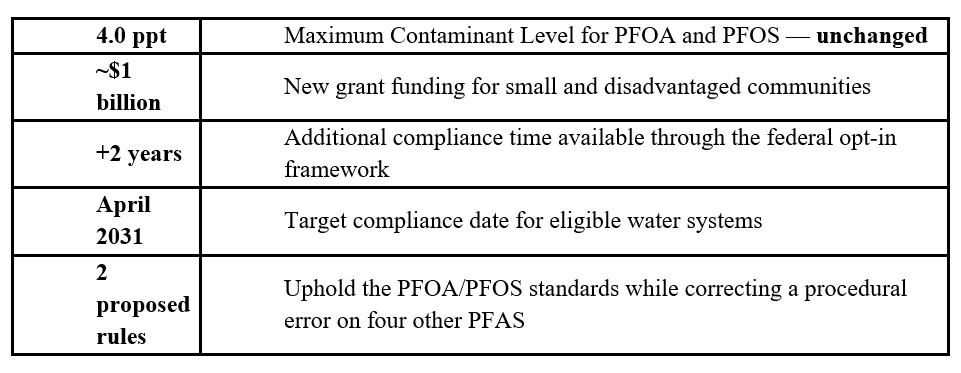
EPA provided a recap of its announcement and expert panel on its Comprehensive PFAS Strategy, clarifying what standards remain in place, how compliance timelines are changing, and what support is available for public water systems. Most importantly, EPA is keeping the enforceable 4 ppt limits for PFOA and PFOS unchanged, along with existing monitoring and reporting requirements, meaning utilities should continue implementing compliance plans based on the 2024 rule. However, operators are being given additional time, until April 2031, to meet those standards, allowing systems to plan and install treatment more deliberately rather than rushing costly or suboptimal solutions.
EPA also proposed rescinding the regulations for four additional PFAS, such as GenX and PFNA, to reevaluate these PFAS for regulation. This PFAS strategy also emphasizes shifting responsibility upstream to industrial dischargers through new pretreatment and discharge limits, which could reduce future source water impacts on utilities. Finally, water systems should be aware of nearly $1 billion in funding and expanded technical assistance programs, particularly aimed at small and disadvantaged systems, to support treatment, monitoring, and planning efforts. |
 |
|
Source |
|
|
|
|
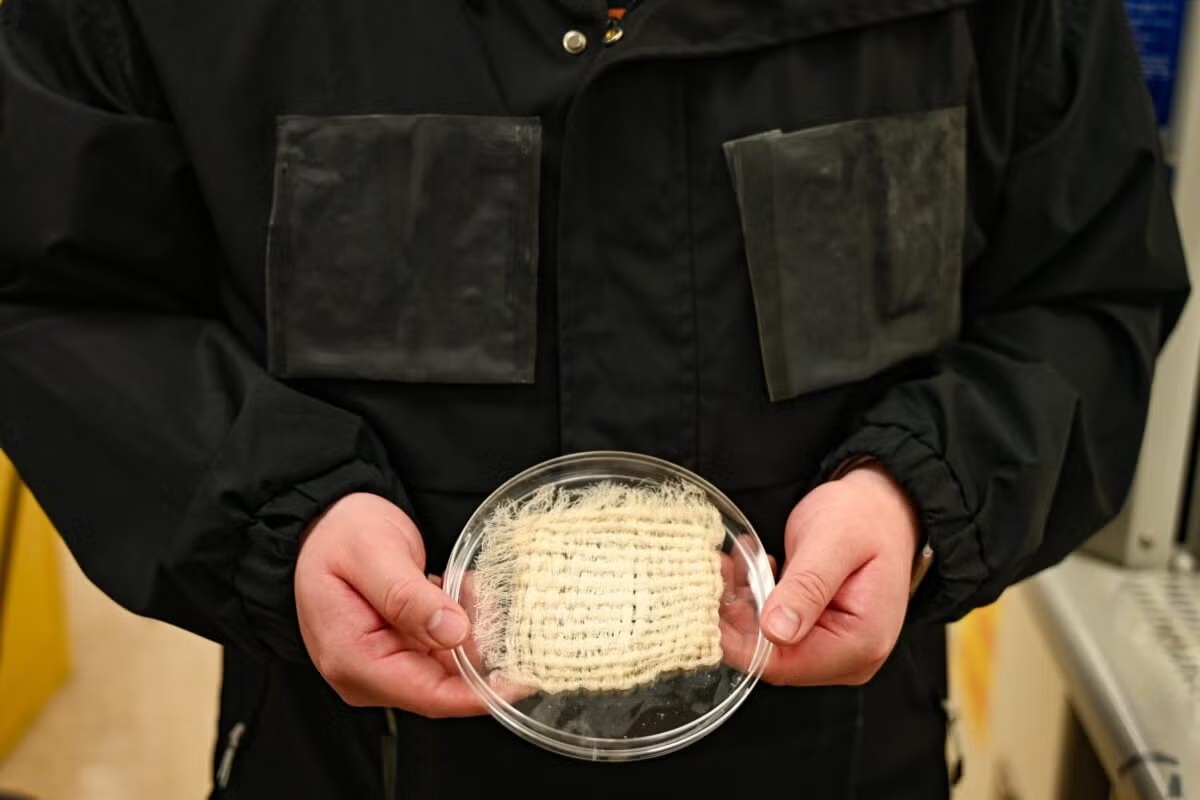
Researchers at the University of Texas at Austin developed a wearable atmospheric water harvesting (AWH) system, a jacket that can produce drinking water directly from air, based on new materials research published in Science Advances. This study addresses a long-standing challenge in AWH, where materials that capture moisture efficiently at small scales often experience reduced performance when scaled for practical applications. The study introduces specially engineered hydrogel-based fibers that can be woven into textiles, allowing for a flexible and breathable material, with large surface area, that can maintain high water harvesting performance outside of laboratory settings. When integrated into a jacket, this textile captures atmospheric moisture and stores it into detachable collection units, producing roughly 400–900 mL of drinking water per day depending on humidity.
This innovative material is composed of fibers that are engineered with an open-pore surface and internal pores that rapidly condenses water vapor on the surface and efficiently transports water into the fiber interior, overcoming the mass-transfer limitations that conventional sorbents often run into. This design allows water to move quickly from vapor to liquid and through the textile, resulting in 3–10× higher performance compared to traditional materials. Combined with low-grade or solar-thermal regeneration, on-body energy harvesting, and embedded sensing, this innovative material could enable continuous, on-the-move potable water production. |
 |
|
Source |
|
|
|
|
|
|
Satellite IoT (Internet of Things) refers to connected sensors and monitoring devices that transmit data through satellite networks rather than relying solely on terrestrial systems like cellular or radio. For water systems, this technology can address a growing operational challenge where many critical monitoring locations, such as reservoirs, river gauges, remote wells, and discharge points, lack reliable connectivity. As regulatory expectations increase in the U.S., utilities are being pushed to not only collect data, but to provide continuous, time-aligned, and verifiable datasets. This article emphasizes that connectivity is often the challenge in ensuring data collection, especially during extreme conditions like storms, when cellular networks degrade or fail. Satellite IoT eliminates this gap by enabling low-bandwidth, highly reliable transmission of critical data (such as alarms, threshold exceedances, and system status) directly from remote assets.
Rather than replacing existing systems, satellite connectivity is often used in a hybrid approach, ensuring that critical data are transmitted in real time even when terrestrial networks fail, while routine data can still use cheaper cellular connections where available. This improves system resilience by removing single points of failure and enables operators to respond quickly to events such as overflows, equipment failures, or water quality issues. This system also creates a clear, time-stamped record from measurement through response, which is increasingly important for regulatory compliance and auditing. Overall, satellite IoT enhances remote water system monitoring by ensuring that data is not only collected, but reliably delivered, enabling utilities to operate more proactively, reduce risk, and meet rising expectations for transparency and accountability.
|
|
Upcoming Events
A listing of webinars, symposia, and conferences relevant to this work. |
|
|
|
|
|
|
The Modern Leak Detection Ecosystem
July 30, 2026 / Virtual 11:00 - 12:00 Mountain Time Zone
American Water Works Association
This webinar will explore how utilities can implement a holistic, system-wide strategy for leak detection, combining traditional methods with advanced technologies like AI to reduce water loss. |
|
|
|
WEFTEC 2026
September 26-30, 2026 / New Orleans, LA
Water Environment Federation
This annual conference brings together water and wastewater professionals from across the globe to showcase the latest innovations, share operational best practices, and explore solutions that advance reliable, efficient, and sustainable water and wastewater management.
|
|
|
|
|
|
|
|
|
|
|
Wastewater | Open Access
Proof-of-principle of Distributed Acoustic Sensing (DAS) for detection of sewer defects, extraneous water intrusion and sewage exfiltration
Zhang, H., Wu, H., Jia, H., Jiang, C., Rijnaarts, H., Chen, W.-S., & Mels, A. (2026). Proof-of-principle of distributed acoustic sensing (DAS) for detection of sewer defects, extraneous water intrusion and sewage exfiltration. Water Science & Technology, 93(11), 1674–1690. https://doi.org/10.2166/wst.2026.291.
Why it's interesting: This study investigates the use of distributed acoustic sensing (DAS) as a novel method for detecting sewer defects that can lead to infiltration/inflow (I/I) and sewage exfiltration, which are two major challenges for wastewater systems. Current inspection methods, such as CCTV and manual surveys, are often limited in coverage, labor-intensive, and unable to detect early-stage or hidden defects, creating a need for continuous, system-wide monitoring technologies. The researchers evaluated DAS, which uses fiber-optic cables as vibration sensors capable of monitoring pipelines over long distances with high spatial resolution. Through both laboratory experiments and an 800 m (2,600 ft) field test, the study demonstrated that DAS can detect and localize sewer defects by analyzing vibration patterns caused by water flow interactions at defect points.
Intrusion events, such as water entering the sewer, produce short, localized vibration spikes, while leakage generates weaker but persistent frequency-based signals that can be identified using power spectral density (PSD) analysis. Fiber‑optic cables laid along the sewer pipe can be used to detect vibration signatures from these events. In field testing, the system successfully identified defective pipe segments despite significant background noise, with results later confirmed using CCTV inspections, demonstrating its value as a screening tool for targeted inspection and maintenance. While still at a proof-of-concept stage, the technology could help utilities move from reactive, intermittent inspections to proactive and data-driven asset management, enabling earlier detection of sewer system issues. |
|
|
Drinking Water | Open Access
Microplastics Removal by Sustainable PVA/Bentonite Membranes: Morphological and Structural Evidence of the Retention Mechanism
Magro, F. S. D., Silvestre, W. P., & Baldasso, C. (2026). Microplastics removal by sustainable PVA/bentonite membranes: Morphological and structural evidence of the retention mechanism. ACS Omega. https://doi.org/10.1021/acsomega.6c02323.
Why it's interesting: This study evaluates the development of sustainable polymer-based membranes for removing microplastics from water. Microplastics are persistent, widespread contaminants that can bypass standard treatment processes and act as carriers for other pollutants, posing risks to the environment and public health. To address these concerns, researchers in this study developed hybrid membranes made from poly(vinyl alcohol) (PVA) reinforced with bentonite clay nanoparticles and evaluated their performance in removing polystyrene microplastics. Through a combination of laboratory filtration experiments and detailed structural analysis, they found that the membranes could achieve extremely high removal efficiencies, averaging approximately 99.78%, while maintaining structural stability. The study also demonstrated that membrane performance is strongly influenced by material composition, with an optimal balance between permeability and structural integrity achieved at lower bentonite concentrations. |
|
|
Drinking Water | Open Access
Repurposing aluminum-based water treatment residual (WTR) as a filtration medium for microplastic removal: Performance, mechanisms, and real-water applicability
Chen, J., Zhang, L., Samaei, S. H.-A., Li, Z., Huang, G., & Xue, J. (2026). Repurposing aluminum-based water treatment residual (WTR) as a filtration medium for microplastic removal: Performance, mechanisms, and real-water applicability. Water Research, 299, 125851. https://doi.org/10.1016/j.watres.2026.125851.
Why it's interesting: This study assessed whether aluminum-based water treatment residuals (WTR), or alum sludge, a common byproduct of drinking water treatment, can be reused as a low-cost filtration medium for removing microplastics from water. The researchers conducted column filtration experiments using WTR with sand and found that the system could remove up to ~97% of microplastics in controlled conditions and 86.9–97.1% in real drinking water and wastewater samples. The study highlights how water chemistry affects performance, showing that factors such as pH, ionic strength, and the presence of dissolved metals (especially aluminum) significantly influence removal by promoting particle aggregation and enhancing retention within the filter media. Overall, the findings suggest that WTR-based filtration could provide utilities with a low-cost, sustainable tool to address microplastics. |
|
|
|
|
Industry News |
|
New method turns ocean water into drinking water, without waste
Researchers at URochester’s Institute of Optics have developed a new solar‑thermal desalination process, using laser‑etched superwicking black metal surfaces to absorb sunlight and continuously separate salt, to efficiently produce fresh water without brine waste or chemical additives.
Research could lead to cheaper, better testing for ‘forever chemicals’ in US drinking water
Researchers at the University of Kansas developed a faster and lower-cost method for detecting PFAS in drinking water by significantly reducing the time and cost needed to prepare and analyze water samples, making routine PFAS monitoring more feasible.
The Tire Industry Project pilots how wastewater treatment can potentially remove tire and road wear particles
The Tire Industry Project launched a real-world pilot at a major wastewater treatment plant in Paris to evaluate how effectively wastewater treatment processes can remove tire and road wear particles from urban runoff.
JEA, local officials celebrate start of $34 million septic tank phase-out project
JEA launched a $34 million project in Northwest Jacksonville, FL to replace hundreds of aging septic tanks with connections to the municipal sewer system, aiming to reduce wastewater pollution and improve water quality and public health.
Scientists want to monitor every river from space
Researchers led by the University of Cincinnati highlighted how satellite remote sensing and modeling can be used to monitor river water quality in near real time, helping utilities better track nutrients, predict harmful algal blooms, and protect drinking water sources. |
|
|
|
|
|
|
|
|
|
|
|
|
|
|
|
WaterOperator.org is a free service, grant-funded to support small community water and wastewater operators with comprehensive resources and information in one easy-to-use place. We also serve the 800+ training, primacy, and technical service organizations, by helping operators get to their information. We aren't selling or advertising anything. Call us at 1-866-522-2681 for assistance. |
|
|
|
|
|
Visit our other websites: |
|
|
|
|
|
|
|
Click here to unsubscribe | Sent to: _t.e.s.t_@example.com
Illinois State Water Survey, 2204 Griffith Drive, Champaign, IL 61820, United States |
|
|
|
|