|
Newsletter #445 - October 20, 2026 |
|
|
|
|
 |
RCAP SRF Workshop Call for Abstracts |
|
The Rural Community Assistance Partnership (RCAP) is soliciting abstracts for the 2027 State Revolving Fund (SRF) Training Workshop, to be held in Seattle, Washington, August 17-19, 2027. The workshop brings together EPA, state SRF programs, technical assistance providers, utilities, consultants, and other partners to share knowledge, strengthen partnerships, and advance effective use of SRF programs for water and wastewater infrastructure projects.
RCAP's goal with this workshop is to provide a collaborative forum for participants to learn from one another and explore innovative ways to advance water and wastewater infrastructure projects through the SRFs. Training sessions should focus on "practical lessons learned, field experience, emerging priorities, and strategies that help communities successfully plan, finance, and implement infrastructure improvements."
Some suggested topic areas include:
-
SRF Fundamentals & Beginner Track: Topics may include SRF basics, funding opportunities, application processes, eligibility requirements, first-time applicant challenges, and successful funding strategies.
-
Utility Capacity Development (Technical/Managerial/Financial): Topics may include asset management, financial management and rate setting, workforce development, capital improvement planning, and small-system sustainability.
-
Compliance & Regulatory Readiness: Topics may include drinking water and wastewater compliance, lead service line and emerging contaminant initiatives, regulatory readiness, technical assistance, construction oversight, and project management.
-
SRF Funding for Resilience, Emergency Response & Cybersecurity: Topics may include emergency response planning, cybersecurity, resilience financing, EPA funding initiatives, risk assessment, and resilience planning.
-
Innovative Infrastructure & Emerging Practices: Topics may include asset management technologies, drones, remote monitoring, biosolids management and reuse, green infrastructure, stormwater, sustainable infrastructure, and innovative planning and delivery methods.
Applicants may submit multiple abstracts and speaker notifications will be sent by the end of January. For any questions, please reach out to Laura Dubin via email.
Abstracts are due Friday, December 4, 2026 |
|
|
|
|
|
|
 |
Register for our free, virtual conference! |
|
Registration is now open for the 2027 Virtual Operator Conference, a free, three-day online training for drinking water operators.
February 2-4, 2027 | 10:30 AM to 3:30 PM Central Time each day
The conference is designed for operators of small and rural systems who may not have the time or budget to travel for training. Every session is taught by a technical assistance provider from the RCAP network: people who work alongside operators every day.
Each day has its own focus:
-
Tuesday, Feb 2: Foundations. The Safe Drinking Water Act, chemistry for operators, and two sessions of water math.
- Wednesday, Feb 3: Distribution and assets. Chlorine residuals and coliform sampling, pumps and motors, asset management, and hydrant assessments.
- Thursday, Feb 4: Source water and preparedness. Groundwater, PFAS, emergency response planning, and using data and GIS during emergencies.
Earn up to 12 hours of CEU credit. CEU approval is in process for all jurisdictions. We'll share approvals as they come in.
|
|
|
|
|
|
|
|
|
|
|
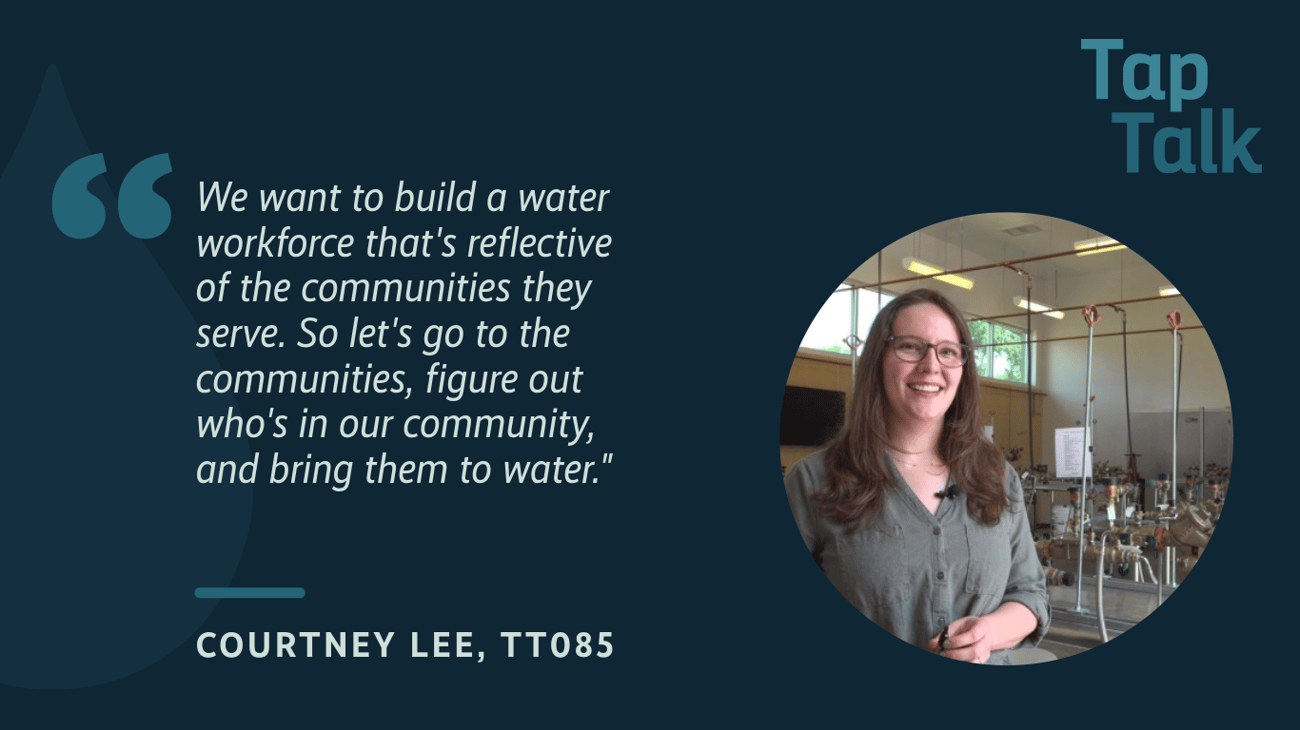 |
Tap Talk |
The Industry Needs You: The Water Tower’s Workforce Vision
Welcome to Tap Talk Season 8! To kick off this new season, we welcome Courtney Lee to the show, who is the Director of Workforce Development at The Water Tower. The Water Tower is a nonprofit innovation hub striving to transform the future of water with research, workforce development, and industry collaboration programs. Courtney talks with Steve and Jennifer about the unique approaches the organization is using to cultivate the next generation of water professionals.
|
|
|
|
|
|
|
Featured Video |
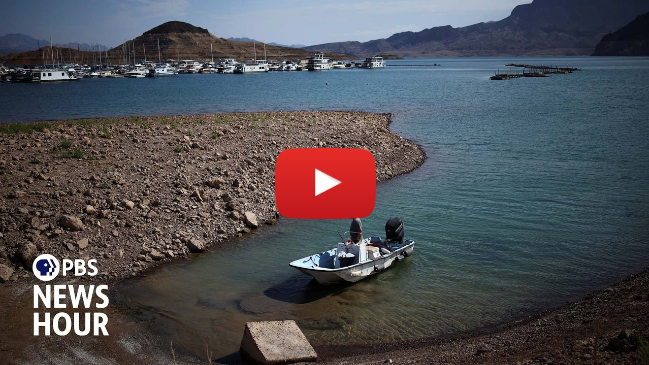 |
How the West is preparing for a drier future as water supplies hit lows
PBS NewsHour
"Mandatory cuts from the federal government on water from the Colorado River will soon take effect in Arizona, Nevada, and California. Now, some water managers in the region are spending billions to prepare for a drier future. Special correspondent Ben Tracy with Climate Central reports for our series, Tipping Point."
|
|
|
|
|
Water Equation Scholarships Close November 6 |
|
The Water Equation Scholarships program supports students and operators at the beginning of their work in water. Scholarships are available through AWWA, corporate partners, and the Water Operator Continuing Education Fund.
The Water Operator Continuing Education Fund supports non-traditional education programs, including trade schools, certification programs, and community college coursework for water operators. To finalize your application, you will need to enter the code WOE.
The Water Operator Continuing Education Fund does not fund scholarships for undergraduate, graduate, or PhD programs. To apply for academic scholarships, visit the Water Equation Scholarships webpage. Water Equation offers 20+ merit-based science, technology, engineering, and math academic scholarships for higher degrees.
For questions about specific program eligibility, contact Margo Hatton (mhatton@awwa.org), CFRE – Senior Manager Development and Donor Relations.
Learn about more continuing education opportunities and section-specific scholarships available through your local AWWA section.
|
| Learn More |
|
|
|
|
Featured Video |
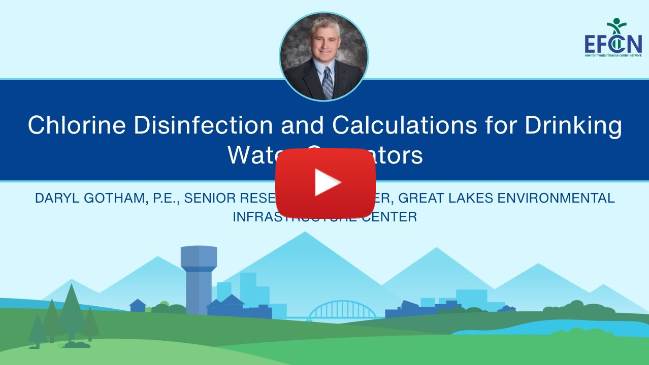 |
Webinar | Chlorine Disinfection and Calculations for Drinking Water Operators
Environmental Finance Center Network
"Chlorine disinfection is one of the most important processes used in drinking water treatment and distribution systems to protect public health. This one-hour webinar provides drinking water operators with an overview of chlorine chemistry, disinfection principles, and the practical calculations required for effective system operation. Participants will learn how chlorine works to inactivate pathogens, the factors that affect disinfection performance, and how to monitor and maintain proper disinfectant residuals throughout the treatment and distribution systems. The webinar will also cover common operator calculations related to chlorine dosage, feed rates, residual concentrations, and contact time (CT). Real-world examples and calculation exercises will help operators strengthen their understanding and confidence in applying chlorine disinfection concepts in daily operations."
|
|
|
|
|
|
|
|
Cybersecurity 201: AI and Emerging Technology Risks for Water Utilities
October 20, 2026 | 1:00 PM ET
U.S. Environmental Protection Agency
EPA's Office of Water Emergency Response and Cybersecurity (OWERC) provides cybersecurity training aimed at expanding cyber knowledge for the water sector. This free training will provide water and wastewater utilities with practical cybersecurity knowledge and actions relevant to the course topic, with an emphasis on improving cybersecurity preparedness, resilience, and overall cyber posture.
Course Objectives:
• Understand basic artificial intelligence and emerging technology terminology.
• Recognize how AI can be used by cyber attackers to increase the speed, scale, and effectiveness of cyber threats.
• Identify common AI-enabled phishing, social engineering, fraud, and misinformation risks.
• Identify low-risk and practical ways utilities can use AI while reducing cybersecurity risks.
• Understand the importance of AI governance, policies, rules, and guardrails.
• Identify immediate actions utilities can take to safely manage the use of AI. |
|
|
|
Cybersecurity 202: Zero Trust Fundamentals for Water Utilities
October 22, 2026 | 1:00 PM ET
U.S. Environmental Protection Agency
EPA's Office of Water Emergency Response and Cybersecurity (OWERC) provides cybersecurity training aimed at expanding cyber knowledge for the water sector. This free training will provide water and wastewater utilities with practical cybersecurity knowledge and actions relevant to the course topic, with an emphasis on improving cybersecurity preparedness, resilience, and overall cyber posture.
Course Objectives:
• Understand the basic concept of Zero Trust and why it is relevant to water utilities.
• Understand foundational Zero Trust principles, including explicit verification, least privilege, and assuming breach.
• Recognize how Zero Trust concepts can be applied to IT, OT, SCADA, remote sites, and vendor access.
• Identify practical, low-cost steps utilities can take to move toward a Zero Trust approach.
• Develop a basic roadmap for implementing Zero Trust practices over time.
|
|
|
|
Water Cybersecurity Assessment Tool (WCAT) Training
October 27, 2026 | 1:00 PM ET
U.S. Environmental Protection Agency
In this free training, EPA's Office of Water Emergency Response and Cybersecurity (OWERC) will demonstrate how to use EPA’s Water Cybersecurity Assessment Tool (WCAT) to conduct cybersecurity assessments at water and wastewater systems. |
|
|
|
Cybersecurity Procurement Checklist Tool Training
October 28, 2026 | 1:00 PM ET
U.S. Environmental Protection Agency
In this free training, EPA's Office of Water Emergency Response and Cybersecurity (OWERC) will demonstrate how to use EPA’s Cybersecurity Procurement Evaluation Checklist for Drinking Water and Wastewater Systems to assess and compare cybersecurity-related vendors. |
|
|
|
Cybersecurity 203: Third-Party and Vendor Risk Management
October 29, 2026 | 1:00 PM ET
U.S. Environmental Protection Agency
EPA's Office of Water Emergency Response and Cybersecurity (OWERC) provides cybersecurity training aimed at expanding cyber knowledge for the water sector. This free training will provide water and wastewater utilities with practical cybersecurity knowledge and actions relevant to the course topic, with an emphasis on improving cybersecurity preparedness, resilience, and overall cyber posture.
Course Objectives:
• Understand why third-party and vendor cybersecurity risks can impact water utility operations.
• Identify vendors and third parties that have access to utility systems, data, and facilities.
• Recognize cybersecurity risks associated with vendor remote access, software, hardware, cloud services, and onsite access.
• Identify practical controls for managing vendor access and reducing supply chain risks.
• Understand basic vendor security expectations that can be incorporated into contracts, purchase orders, and vendor relationships.
• Identify initial steps utilities can take to improve vendor risk management. |
|
|
|
|
|
|
|
|
|
|
Recent Blog Posts at WaterOperator.org |
|
|
 |
|
Build Your Own Cybersecurity Awareness Month Campaign
Read Here » |
|
|
 |
|
Resilience and Emergency Preparedness Resources for Wastewater Utilities
Read Here »
|
|
|
|
|
|
Groundwater & Well Care for Public Water Systems is a free online course from WaterOperator.org. Certificates are provided and the course is currently pre-approved for 2 hours continuing education credit in a number of states.
Click here to learn more. |
|
|
|
|
|
|
|
|
|
WaterOperator.org is a free service, grant-funded to support small community water and wastewater operators with comprehensive resources and information in one easy-to-use place. We also serve the 800+ training, primacy, and technical service organizations, by helping operators get to their information. We aren't selling or advertising anything. Call us at 1-866-522-2681 for assistance. |
|
|
|
|
|
Visit our other websites: |
|
|
|
|
|
|
|
Click here to unsubscribe | Sent to: _t.e.s.t_@example.com
Illinois State Water Survey, 2204 Griffith Drive, Champaign, IL 61820, United States |
|
|
|
|
|
|