|
Newsletter #130 for July 2026 |
|
|
|
|
|
|
|
|
|
EPA has awarded $3.6 million through its Small Business Innovation Research (SBIR) program to help nine small businesses further develop and commercialize innovative environmental technologies. Several of the funded projects have direct relevance to municipal water and wastewater utilities, including solutions for water quality monitoring and PFAS management.
Among the recipients, Page Technologies will advance a low-cost electrochemical nitrate sensor designed for long-term, in situ deployment. The technology aims to provide continuous, real-time nitrate monitoring for wastewater treatment applications, potentially improving process control while reducing monitoring costs.
Another recipient, AxNano, Inc., is developing a treatment technology for PFAS-contaminated biosolids. The technology is intended to prevent PFAS compounds from re-entering the environment, addressing a growing challenge for utilities facing increasing regulatory and public scrutiny with biosolids management.
Future SBIR funding opportunities and Success Stories can be found on the program page. |
|
|
|
|
EPA has released a draft guidance to help wastewater utilities, landowners, and the public reduce risk from PFOA and PFOS in biosolids. The guidance is part of EPA’s broader PFAS strategy and recommends risk-reduction measures, including avoiding land application of biosolids near waterways, on areas where children frequently play, and as fertilizer on crops with a higher risk of human exposure. EPA is now seeking public input before finalizing the guidance and emphasizes the need to balance public health protection with supporting wastewater systems and beneficial use of biosolids when appropriate. The agency will accept public comments for 60 days following publication in the Federal Register (Docket ID No. EPA-HQ-OW-2026-2509).
|
|
|
|
|
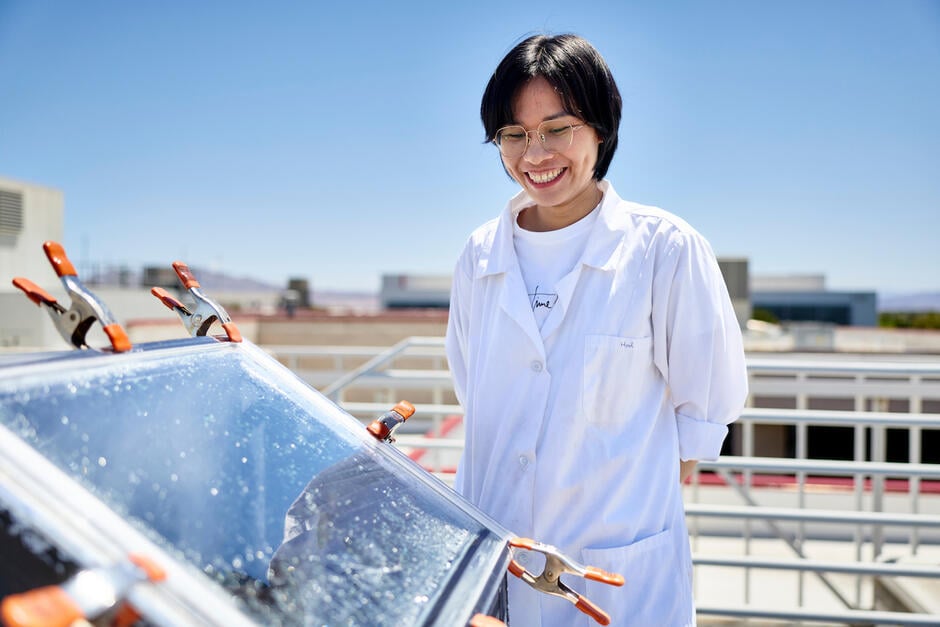
A research team at the University of Nevada, Las Vegas (UNLV) are developing a solar-powered wastewater reuse system designed for rural households in arid regions. The project focuses on treating graywater from showers, kitchen sinks, and laundry through a two-step process that combines filtration using naturally sourced materials, including sand, woodchips, and biochar, with solar distillation powered by the desert sun. Researchers report that the system has produced high-quality treated water in laboratory testing and are preparing to move from laboratory-scale evaluation to onsite pilot testing.
The household-scale system is being designed as a modular, "plug-and-play" unit that will allow users to easily maintain and replace the filtration media. The next phase of the project involves partnering with rural communities in Nevada to test the technology under real-world conditions while addressing public perceptions surrounding wastewater reuse. Researchers hope the project will help communities view wastewater as a reusable resource rather than a waste product and demonstrate the potential of decentralized water reuse technologies in water-scarce regions. |
 |
|
Source |
|
|
|
|
|
|
The Water Research Foundation (WRF) is accepting proposals for eight new research projects aimed at addressing key challenges facing water and wastewater utilities. Funded through WRF’s Research Priority Program, the projects focus on topics including machine learning for valve prioritization, AI-based water quality monitoring, workforce development, drought management, anaerobic digestion, distribution system recovery after extreme events, biological nutrient removal performance, and asset health monitoring for buried infrastructure. WRF noted that an additional 17 research projects are expected to be released later this summer, providing additional opportunities for utilities, researchers, and industry partners to contribute.
|
|
|
|
|
WRF, in partnership with the California State Water Resources Control Board, is also seeking proposals for seven new research projects funded through a $1.5 million grant program aimed at advancing water reuse innovation across California.The projects focus on key technical and regulatory challenges including concentrate management and treatment, direct potable reuse (DPR) treatment equivalency, and aquifer geochemistry. The multi-year grant program, which spans from 2025 to 2030, is intended to support research that accelerates the implementation of safe and sustainable water reuse practices. Proposals are due by September 2, 2026.
|
|
|
|
|
EPA has proposed the Sixth Unregulated Contaminant Monitoring Rule (UCMR 6), which would require public water systems to monitor for 30 unregulated contaminants between 2028 and 2030, including several ultrashort-chain PFAS, pesticide metabolites, and organic compounds. Notably, the proposed rule does not include microplastics, despite petitions from several states and environmental groups, because EPA determined that no validated analytical method currently exists to generate consistent nationwide monitoring data. Public comments on the proposed rule are due by August 31, 2026
|
|
|
|
|
This article discusses the growing role of smart valves in modern water infrastructure, highlighting that utilities are moving beyond simply monitoring system conditions toward technologies that can automatically respond to operational issues. Unlike traditional metering systems that only detect leaks or abnormal conditions, smart valves can remotely isolate leaks, automate service workflows, manage pressure events, and support emergency shutoffs in real time. The article notes that advances in IoT technology, software platforms, and cybersecurity, along with increasing pressure to reduce water loss and operating costs, are accelerating adoption of these systems. As utilities plan future meter and infrastructure upgrades, the author recommends evaluating smart valves to support more resilient and intelligent infrastructure.
|
|
Upcoming Events
A listing of webinars, symposia, and conferences relevant to this work. |
|
|
|
|
|
|
Advancing PFAS Removal From Pilot to Plant
September 3, 2026 / Virtual 11:00 - 12:00 Mountain Time Zone
American Water Works Association
This webinar will present an innovative PFAS treatment technology designed to help drinking water utilities meet EPA’s new PFAS drinking water standards. |
|
|
|
|
|
|
|
|
|
|
|
|
Wastewater | Open Access
Assessment of an air-assisted wet separation process for microplastic reduction in sewage sludge
Pérez-López, A., Navarro-Úbeda, M., Santos, A., Cotillas, S., & Domínguez, C.M. (2026). Assessment of an air-assisted wet separation process for microplastic reduction in sewage sludge. Process Safety and Environmental Protection, 214, 109031. https://doi.org/10.1016/j.psep.2026.109031.
Why it's interesting: This study evaluated a chemical-free air-assisted wet separation process for removing microplastics from sewage sludge, addressing growing concerns about the accumulation of microplastics in biosolids and their potential transfer to agricultural soils. The process uses fine air bubbles to selectively attach to and float microplastics into a small overflow stream while minimizing sludge losses. Researchers found that sludge preconditioning (drying and size reduction) was essential for effective separation, and under optimized conditions achieved approximately 80% microplastic separation with less than 2.5% sludge loss. Removal efficiency increased with particle size, exceeding 90% for microplastics larger than 3 mm, while polymer type and particle shape (fragments versus fibers) had relatively little impact on performance. The process also maintained more than 70% separation efficiency across sludges from different wastewater treatment plants and required relatively low energy input.
|
|
|
Drinking Water | Open Access
Breakthrough and desorption of PFAS in aged GAC filters during drinking water treatment – a question of DOM composition
McEvoy, A., Szopińska, M., Kozłowska-Tylingo, K., Murphy, K., Cimbritz, M., Davidsson, Å., & Falås, P. (2026). Breakthrough and desorption of PFAS in aged GAC filters during drinking water treatment – a question of DOM composition. Water Research, 304, 126326. https://doi.org/10.1016/j.watres.2026.126326.
Why it's interesting: This study examined how changes in dissolved organic matter (DOM) composition affect PFAS removal in aged granular activated carbon (GAC) filters used for drinking water treatment. Using column tests with GAC taken from a full-scale PFAS treatment system, the researchers found that changes in feedwater DOM quality, that can occur during seasonal changes and runoff events, can reduce PFAS removal performance and even cause previously adsorbed short-chain PFAS to desorb from the carbon. The results showed that lower molecular weight DOM compounds competed with PFAS for adsorption sites, leading to increased PFAS breakthrough and poorer PFOA removal despite similar dissolved organic carbon (DOC) concentrations. Longer-chain PFAS and sulfonates continued to be removed more effectively than shorter-chain PFAS and carboxylates, but overall performance declined when the incoming water contained a different DOM composition than the GAC was designed for. The findings highlight that utilities operating GAC systems for PFAS control should pay attention not only to DOC levels but also to changes in DOM quality and aromaticity.
|
|
|
Wastewater | Open Access
Removal of organic micropollutants in granular activated carbon filters – review of long-term and full-scale experiences from municipal wastewater treatment
Cimbritz, M., Falås, P., Betsholtz, A., Edefell, E., Gidstedt, S., Takman, M., Svahn, O., & Davidsson, Å. (2026). Removal of organic micropollutants in granular activated carbon filters – review of long-term and full-scale experiences from municipal wastewater treatment. Water Science & Technology, 94(1), 108-122. https://doi.org/10.2166/wst.2026.313.
Why it's interesting: This review summarizes long-term pilot- and full-scale studies using GAC filtration for the removal of pharmaceuticals and other organic micropollutants from wastewater. The authors found that GAC filters can provide effective micropollutant removal for extended periods, with several studies maintaining strong performance beyond 30,000 bed volumes. However, filter lifespan varies considerably depending on the compounds being monitored, pretreatment processes, carbon type, and operating conditions. The review also highlights that GAC filters gradually develop biological activity, meaning pollutant removal can shift from primarily adsorption to a combination of adsorption and biodegradation over time. The findings suggest that proper design, monitoring, and carbon replacement strategies will be crucial for maintaining long-term treatment performance while controlling operating costs. |
|
|
|
|
|
|
|
|
|
|
|
|
|
|
|
|
|
|
|
WaterOperator.org is a free service, grant-funded to support small community water and wastewater operators with comprehensive resources and information in one easy-to-use place. We also serve the 800+ training, primacy, and technical service organizations, by helping operators get to their information. We aren't selling or advertising anything. Call us at 1-866-522-2681 for assistance. |
|
|
|
|
|
Visit our other websites: |
|
|
|
|
|
|
|
Click here to unsubscribe | Sent to: _t.e.s.t_@example.com
Illinois State Water Survey, 2204 Griffith Drive, Champaign, IL 61820, United States |
|
|
|
|