|
Newsletter #125 for February 2026 |
|
|
|
|
|
|
|
|
|
EPA has released the 11th set of data collected under the fifth Unregulated Contaminant Monitoring Rule (UCMR 5), covering 29 PFAS and lithium in drinking water systems. This update includes approximately 1.9 million sample results from 10,299 public water systems, representing about 95% of all expected results from the 2023–2025 monitoring cycle. The accompanying data summary report noted how the overall dataset showed that a number of systems reported annual average PFAS levels above newly established MCLs, with national weighted estimates indicating about 8% of systems exceeded at least one PFAS MCL, and with exceedance patterns varying by system size. Lithium was also found above EPA’s screening reference concentration in 28% of small systems and 24% of large systems.
This near‑complete dataset gives utilities valuable insight into PFAS occurrence and co‑occurrence patterns nationwide, helping them better understand local contamination potential and plan future monitoring or treatment needs. The data also supports EPA’s PFAS OUT initiative, which provides water systems with technical assistance, operator training, risk communication support, water quality testing, and help accessing federal funding to address PFAS in drinking water.
Utilities, regulators, and community members can explore system‑specific results using EPA’s UCMR 5 Data Finder tool, which allows users to filter, view, and download data for analysis or public outreach. A video walkthrough on how to access and utilize the tool is also available.
The 12th and final UCMR 5 data is expected to be released in early fall 2026. |
|
|
|
|
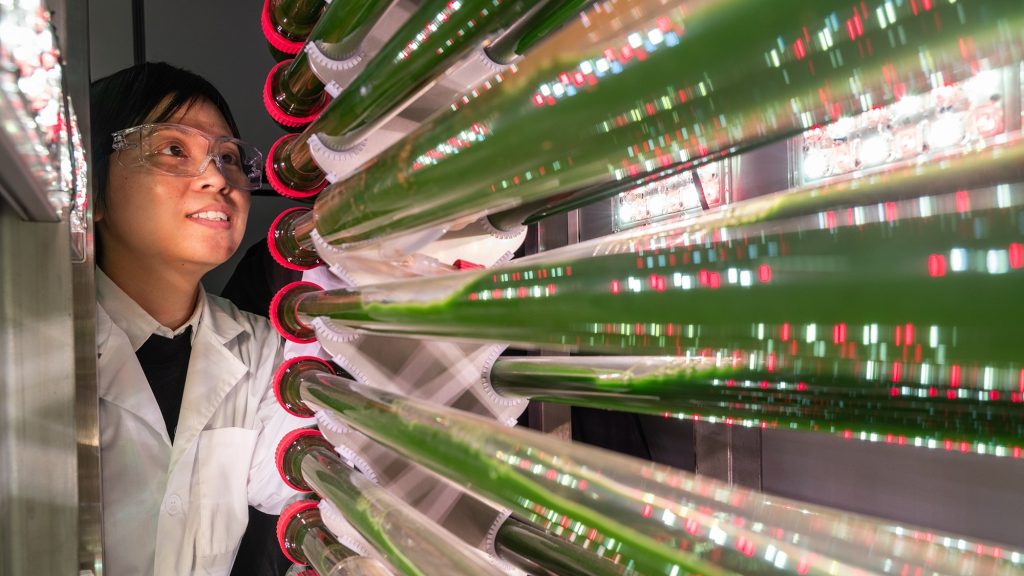
Researchers at the University of Missouri have developed a genetically engineered strain of algae capable of removing microplastics from polluted water. This engineered algae produce limonene, a natural water‑repellent oil that causes the algae to bind with microplastics, which are also hydrophobic, forming clumps that sink and can be easily filtered. This algae also thrives in wastewater, consuming excess nutrients while simultaneously capturing microplastics, creating a biomass layer that can be removed and potentially repurposed into bioplastic products, such as composite plastic films. The research team currently grows algae in large tank bioreactors to process industrial flue gas to help clean air pollution, and they hope to build a larger bioreactor that can be adapted for wastewater treatment.
Algae‑based treatment systems have gained significant traction in recent years due to their ability to simultaneously remove pollutants and recover valuable resources in a sustainable, low‑energy manner. Studies highlight that algae can efficiently remove nutrients, pathogens, heavy metals, and a wide range of pollutants while generating useful biomass for biofuels, fertilizers, and bioproducts. Additionally, microalgae have shown strong potential for removing emerging contaminants, including pharmaceuticals, personal‑care products, endocrine disruptors, and other chemicals of concern. As utilities start considering more sustainable processes, algae‑based systems are increasingly viewed as promising solution. |
 |
|
Source |
|
|
|
|
|
|
Scientists at Flinders University, Australia have developed a nano‑sized molecular “cage” that can trap and remove PFAS contaminants from drinking water. The cage works by forcing PFAS molecules to aggregate inside its internal cavity, creating an unusually strong binding interaction that differs from traditional adsorbents. When these molecular cages are embedded into mesoporous silica, a material that normally shows no PFAS affinity, the composite becomes highly effective at capturing a broad range of PFAS chemicals. Laboratory tests showed the material can remove up to 98% of PFAS at environmentally relevant concentrations in tap water, and remains effective after at least five reuse cycles, highlighting its potential viability for water filtration systems.
This nano‑cage technology represents a promising advancement for PFAS treatment because it directly addresses the removal of short‑chain PFAS, which are highly mobile in water and resist standard filtration methods like activated carbon. By providing a highly selective adsorbent that binds PFAS more effectively compared to traditional materials, this approach could offer water treatment facilities with a new process for polishing water at the final treatment stage, improving water quality and public health.
|
|
|
|
|
The Water Research Foundation is accepting pre‑proposals for its 2026 Unsolicited Research Program, which funds novel, transformative research projects that advance scientific understanding and deliver practical solutions to water quality challenges. For this cycle, WRF has allocated $1,893,095 in total funding, with individual project awards ranging from $50,000 to $200,000. Eligible projects may address drinking water, wastewater, reuse, or stormwater topics and can include piloting new technologies or tackling regionally or nationally significant issues. Pre‑proposals, which will be evaluated based on technical and scientific merit, originality, research approach, significance and value, as well as project schedule and team qualifications, should be submitted by March 26, 2026. |
|
Upcoming Events
A listing of webinars, symposia, and conferences relevant to this work. |
|
|
|
Utility Management Conference
March 24-27, 2026 / Charlotte, NC
Water Environment Federation / American Water Works Association
This annual conference is a national gathering of water and wastewater utility leaders focused on strengthening utility performance, advancing innovative management practices, and supporting the circular water economy model. |
|
|
|
AI + Satellite Technology to Reduce NRWs and Monitor Critical Assets
March 31, 2026 / Virtual 11:00 - 12:00 Mountain Time Zone
American Water Works Association
This free webinar explores how satellite‑based leak detection and AI‑driven analytics are helping water utilities to monitor large service areas, improve operational efficiency, and strengthen data‑driven asset management. |
|
|
|
|
|
|
|
|
|
|
|
|
Drinking Water | Open Access
Risk assessment of trihalomethanes in drinking water with seasonal variation considerations
Hosny, G., Elden, A., & Aborhyem, S. (2026). Risk assessment of trihalomethanes in drinking water with seasonal variation considerations. Scientific Reports, 16, 5372. https://doi.org/10.1038/s41598-025-30481-9.
Why it's interesting: This study provides a detailed assessment of seasonal fluctuations in trihalomethane (THM) levels and associated cancer risks across seven drinking‑water districts in Alexandria, Egypt. Researchers sampled water during summer and winter periods, and found that THM levels varied widely, with some areas experiencing levels over 150–196 µg/L, especially during warm weather when chlorine reacts more quickly with organic material. Sample analysis showed that chloroform was the biggest driver for both health risks and regulatory exceedances, and that wintertime stagnation and site‑specific treatment issues could also create unexpectedly high THM levels. The work highlights the importance of regular seasonal monitoring, optimizing chlorine dosing, maintaining residuals without over‑chlorinating, improving mixing and turnover in storage tanks, and considering alternative treatment strategies (ex. UV, ozone, precursor removal) to minimize THM formation and maintain compliance.
|
|
|
Drinking Water | Not Open Access
Jet Drop Enrichment: A Low-Cost Method for Simultaneous PFAS and Microplastics Removal from Drinking Water
Ma, X., Liu, X., Chu, W., Liu, M., Jiang, X., Lu, X., Wang, Z., & Wang, X. (2026). Jet Drop Enrichment: A low‑cost method for simultaneous PFAS and microplastics removal from drinking water. ACS ES&T Engineering. https://doi.org/10.1021/acsestengg.5c01036.
Why it's interesting: This study introduces a novel, low‑cost drinking‑water treatment technology called Jet Drop Enrichment (JDE), which uses bubbles rising and bursting at the water surface to remove both PFAS and fine microplastics, two emerging contaminants that conventional treatment technologies often fail to remove. As bubbles reach the surface and burst, they produce jet drops that selectively capture pollutants that accumulate at the air–water interface. Laboratory testing showed that long‑chain PFAS were highly surface‑active and achieved removal efficiencies close to 90–99%, while 5–10 μm MPs reached up to 99% removal under the same conditions. However, short‑chain PFAS were removed far less effectively due to their weaker surface activity.
To address this challenge, researchers combined JDE with anion‑exchange resin (AER) pretreatment, significantly improving short‑chain PFAS removal to greater than 90% while using far less resin than traditional fixed‑bed systems would require. This integrated JDE + AER system maintained high removal of long‑chain PFAS and microplastics and reduced operational costs to approximately $0.13 per cubic meter, compared to more costly conventional approaches ($0.58~0.63 per cubic meter). The findings demonstrate that bubble‑burst‑driven processes offer a compact, modular, and energy‑efficient way to remove PFAS and microplastics.
|
|
|
Wastewater | Not Open Access
Coupled UASB–GDM system with electrospun nanofiber membranes for decentralized wastewater treatment
Taher, M. N., Al‑Mutwalli, S. A., Owusu‑Agyeman, I., Dereli, R. K., Cetecioglu, Z., Koseoglu‑Imer, D. Y., & Lipnizki, F. (2026). Coupled UASB–GDM system with electrospun nanofiber membranes for decentralized wastewater treatment. Water Research, 295, 125551. https://doi.org/10.1016/j.watres.2026.125551.
Why it's interesting: This study evaluated an innovative decentralized wastewater treatment system that utilizes an up‑flow anaerobic sludge blanket (UASB) reactor with a gravity‑driven membrane (GDM) filtration unit using electrospun nanofiber membranes (ESNs). The system is designed so that when wastewater first enters the UASB reactor, most of the organics are broken down anaerobically, and the partially treated flow then moves into a gravity‑driven membrane tank where a naturally forming biofilm on the nanofiber membranes provides final polishing by trapping solids and nutrients, allowing stable, low‑energy treatment without pumps, backwashing, or chemicals. The study demonstrates how this UASB-GDM system can deliver low‑energy, low‑maintenance wastewater treatment suitable for decentralized and small‑community applications, with potential for non‑potable reuse. |
|
|
|
|
|
|
|
|
|
|
|
|
|
|
|
|
|
|
|
WaterOperator.org is a free service, grant-funded to support small community water and wastewater operators with comprehensive resources and information in one easy-to-use place. We also serve the 800+ training, primacy, and technical service organizations, by helping operators get to their information. We aren't selling or advertising anything. Call us at 1-866-522-2681 for assistance. |
|
|
|
|
|
Visit our other websites: |
|
|
|
|
|
|
|
Click here to unsubscribe | Sent to: _t.e.s.t_@example.com
Illinois State Water Survey, 2204 Griffith Drive, Champaign, IL 61820, United States |
|
|
|
|


