Newsletter #122 for November 2025
|
|
|
|
|
|
|
|
|
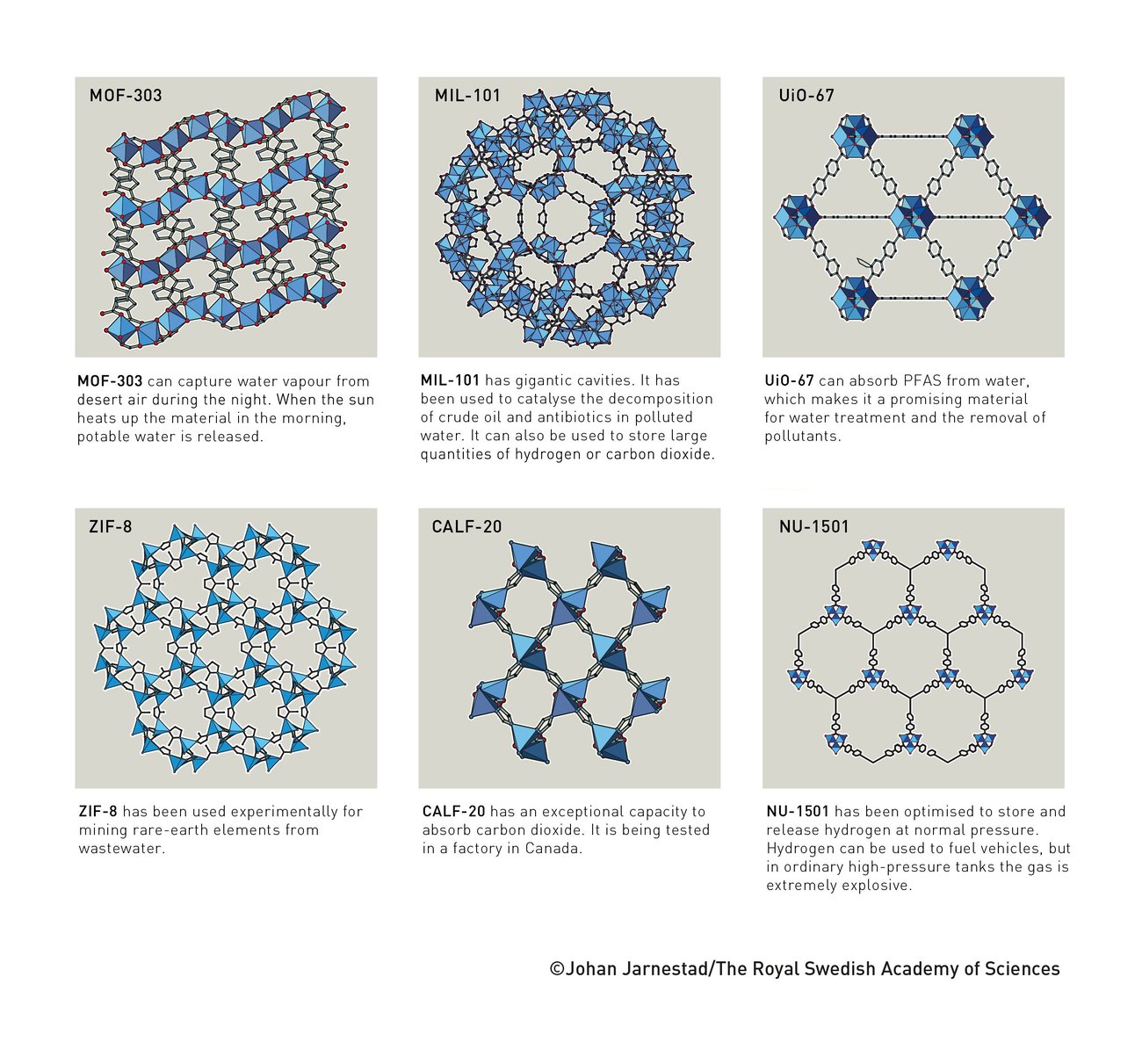
The 2025 Nobel Prize in Chemistry was awarded to Susumu Kitagawa, Richard Robson, and Omar Yaghi for developing metal organic frameworks (MOFs), which are highly porous crystalline materials made from metal ions and organic linkers that form structures with larger surface areas. These “molecular sponges” can selectively capture, store, and release molecules such as water, carbon dioxide, and hydrogen. For water and wastewater utilities, MOFs are exciting because they enable water harvesting from arid air, removal of pollutants like PFAS, and advanced desalination or reuse processes. These innovative materials can allow utilities to target specific contaminants
and improve resource recovery, offering a more sustainable and resilient solution.
|
 |
|
|
Source
|
|
|
EPA has released the tenth set of monitoring results under the Fifth Unregulated Contaminant Monitoring Rule (UCMR 5), covering data collected between 2023 and 2025. This dataset includes sample results from public water systems around the country, representing about 89% of the total data expected by 2026. UCMR 5 tracks 30 chemical contaminants, 29 PFAS and lithium, across large to small systems. The Data Summary Report includes a summary of the findings, notably showing large
numbers of systems reporting lithium above reporting limits. Data can be found on the UCMR 5 Data Finder tool, allowing users to search for contaminant, state, and system size-specific results.
|
|
|
AWWA recently published their Cooling the Cloud: Water Utilities in a Data-Driven World report to help utilities prepare for incoming data centers and their impacts on water systems. Data centers can consume millions of gallons of water daily for cooling, creating challenges for water supply, treatment capacity, and distribution infrastructure. Clustering of facilities amplifies these impacts, especially in water-stressed regions. Utilities may face increased costs, infrastructure
strain, and potential conflicts over water rights. To prepare, utilities should engage early with developers, assess source and treatment capacity, plan for transmission upgrades, and consider alternatives like reclaimed water or low-water cooling technologies. This report guides utilities in assessing and integrating data centers as appropriately into their communities.
|
|
|
This article, featured in NEWEA’s Fall 2025 Journal, highlights the Boston Water and Sewer Commission and their proactive approach to climate resilience by developing a citywide flood model that predicts flooding from extreme rainfall combined with rising sea levels. By integrating decades of rainfall data, coastal flood projections, and real-time emergency planning tools, BWSC developed a powerful resource to strengthen their city’s climate resiliency. The model is showcased through an interactive public website with 360-degree flood visualizations, a dashboard to assess impacts on critical facilities, and conceptual designs for adapting stormwater
infrastructure as gravity drainage becomes less effective.
|
|
|
EPA has announced the availability of $7 billion in funding through the Water Infrastructure Finance and Innovation Act (WIFIA) and State WIFIA (SWIFIA) programs to accelerate water infrastructure improvements nationwide. WIFIA loans can cover up to 49% of a project’s cost (80% for small systems with significant challenges) and offer flexible repayment terms, making them ideal for utilities looking for funding opportunities for infrastructure projects.
Project types are wide-ranging and include, but are not limited to, projects that:
Improve water quality
Support compliance with drinking water standards and wastewater permit requirements
Reduce stormwater runoff
Modernize aging water infrastructure
Address PFAS and other emerging contaminants
Remove lead service lines
Ashland, a small, rural community in Oregon will receive a $73 million WIFIA loan to help build a new drinking water treatment plant to provide a safer and more resilient supply of clean drinking water.
Applications are being accepted by EPA on a rolling basis. Interested utilities and communities are encouraged to submit a letter of Interest and explore technical assistance opportunities to maximize access to these funds.
|
|
Upcoming EventsA listing of webinars, symposia, and conferences relevant to this work.
|
|
|
Leveraging Technology & AI in Workforce Operations
December 10, 2025 / Virtual 13:00 - 14:30 Eastern Time Zone
Water Environment Federation
This free webcast will highlight how leading utilities across the US are using technology and AI to strengthen workforce performance, increase operational efficiency, and build long-term resilience.
|
|
|
Low Flows, High Impact
December 11, 2025 / / Virtual 11:00 - 12:00 Mountain Time Zone
American Water Works Association
This free webinar will explore how integrating metering, pressure monitoring, and AMI data can optimize water distribution performance.
|
|
|
Bridging the Gap: Budget and Resilience
December 16, 2025 / Virtual 11:00 - 12:00 Mountain Time Zone
American Water Works Association
This free webinar will showcase Mueller’s cost-effective, scalable solution that enables utilities to renew critical hydrant components and upgrade their hydrant networks without costly excavation or site remediation.
|
|
|
|
|
|
|
|
|
|
Wastewater | Open Access
A review on low-temperature denitrification technologies: evolution, mechanisms and prospects for sustainable wastewater treatment
Miao, L., Zhu, Y., Luo, D., Adyel, T.M., You, G., Wu, J., Kong, M., Wang, W., Hou, J., He, C., & Liu, Y. (2025). A review on low-temperature denitrification technologies: evolution, mechanisms and prospects for sustainable wastewater treatment. Water Science & Technology, 92(9), 1343–1359. https://doi.org/10.2166/wst.2025.157.
Why it's interesting: This report addresses the challenge of achieving effective denitrification in wastewater treatment under low-temperature conditions, which significantly inhibits microbial activity and enzyme functions. It highlights the transition from using traditional methods like constructed wetlands and activated sludge to advanced processes such as solid-phase denitrification (SPD), partial denitrification/anammox (PD/A), biofilm reactors, and aerobic granular sludge. The report highlights how SPD stands out for its high nitrate removal efficiency (~91%) through sustained carbon release and enhanced electron transfer, while PD/A offers energy savings and reduced greenhouse gas emissions by avoiding temperature-sensitive
enzymatic steps. The paper outlines the technology and economic trade-offs of these advanced processes, their environmental benefits, and future improvements, including AI-driven optimization of carbon sources and biofilm-based strategies to enhance microbial resilience.
|
|
Drinking Water | Open Access
Predicting regulated and emerging disinfection byproducts in small drinking water catchments using machine learning
Droz, B., Fernández-Pascual, E., O’Dwyer, J., Goslan, E.H., Quishi, X., O’Driscoll, C., Harrison, S., & Weatherill, J. (2025). Predicting regulated and emerging disinfection byproducts in small drinking water catchments using machine learning. Environment International, 206, 109923. https://doi.org/10.1016/j.envint.2025.109923.
Why it's interesting: This study demonstrates the use of machine learning (ML) models to predict the formation of regulated and emerging disinfection byproducts (DBPs) in small drinking water catchments based on dissolved organic matter (DOM) spectroscopic data and hydrochemical parameters. The study focused on small drinking water catchments in Ireland, where raw water often contains high DOM, increasing the risk of DBP formation during chlorination. Researchers collected surface water and groundwater samples from multiple points across two catchments, from upland peat soils to lowland agricultural areas. Laboratory chlorination experiments were then performed under controlled conditions (pH 7, 25 °C, 72 hours) to simulate DBP
formation potential and monitor DBP concentrations. This data was then used to train a ML model, which was able to accurately predict DBP formation based on raw water sample data. This approach helps identify DBP risks early, without waiting for lab results after treatment, and can also be scaled up to integrate rapid or real-time monitoring.
|
|
Wastewater | Not Open Access
Microbial Communities Shape Chemical Fate during Wastewater Treatment: Implications for Low-Cost Treatment Optimization
Olland, M., Hernandez, A., Droz, B., Fender, C.L., La Joie, A., Garcia-Jaramillo, M., Navab-Daneshmand, T., & Jones, G.D. (2025). Microbial communities shape chemical fate during wastewater treatment: Implications for low-cost treatment optimization. ACS ES&T Water. https://doi.org/10.1021/acsestwater.5c00660.
Why it's interesting: This study examined how microbial communities in conventional wastewater treatment processes influence the removal of emerging contaminants such as pharmaceuticals and industrial chemicals. Researchers sampled 12 municipal plants in Oregon using activated sludge (AS), biological nutrient removal (BNR), and lagoons (LAG). Grab samples were collected before and after treatment and analyzed for microbial and chemical composition.
The study found that:
Different systems foster specific microbial communities, which in turn drive distinct chemical transformation patterns.
AS and BNR systems were more effective at removing certain pharmaceuticals and surfactants (ex. isoflupredone, cocamidopropyl betaine), while lagoon systems better transformed compounds like umbelliferone, likely due to longer retention times and sunlight exposure.
Eleven chemical classes and seven subclasses were significantly impacted by treatment type, showing that operational processes strongly influence contaminant fate.
Network analysis revealed specific microbial groups were linked to chemical classes, suggesting that adjusting aeration, retention time, or bioaugmentation could enhance removal of priority contaminants without costly infrastructure upgrades.
|
|
|
|
|
Industry News |
3 Nanotech Breakthroughs Revolutionizing Water Purification Worldwide
Nanotechnology is transforming water purification by using advanced materials like graphene membranes, carbon nanotubes, and metal nanoparticles to deliver faster, cleaner, and more energy-efficient treatment solutions that tackle contaminants conventional systems often miss.
Student Innovators Shine at Grainger Computing Innovation Prize Competition
Illinois Tech students won the Grainger Computing Innovation Prize for creating Drain Watch, a sensor system for sewer drain covers that sends real-time data to municipal crews to help prevent flooding and improve maintenance planning.
Stantec launches three water research and innovation programs
Stantec has launched three water research programs focused on PFAS removal, sustainable nutrient reduction through process intensification, and machine learning for I&I predictive maintenance, aiming to help utilities improve treatment performance, cost-efficiency, and regulatory compliance.
New Mexico expands satellite-based leak detection program to curb drinking water losses
New Mexico signed a four-year agreement to expand its satellite-based leak detection program with ASTERRA, aiming to help small and rural utilities reduce water losses by identifying hidden leaks and supporting repairs, building on a pilot that saved 345,000 gallons per day.
Researchers find simple way to destroy PFAS on activated carbon
Researchers at Clarkson University developed a simple, chemical-free method to destroy PFAS by milling granular activated carbon in stainless steel ball mills, using triboelectrons from steel ball collisions to break down PFAS at room temperature, making treated carbon safe for disposal.
|
|
|
|
|
|
|
|
|
|
|
|
|
|
|
WaterOperator.org is a free service, grant-funded to support small community water and wastewater operators with comprehensive resources and information in one easy-to-use place. We also serve the 800+ training, primacy, and technical service organizations, by
helping operators get to their information. We aren't selling or advertising anything. Call us at 1-866-522-2681 for assistance.
|
|
|
|
|
Visit our other websites:
|
|
|
|
|
|
|
Click here to unsubscribe | Sent to: _t.e.s.t_@example.com
Illinois State Water Survey, 2204 Griffith Drive, Champaign, IL 61820, United States
|
|
|
|
|


