|
Newsletter #124 for January 2026 |
|
|
|
|
|
|
|
|
|
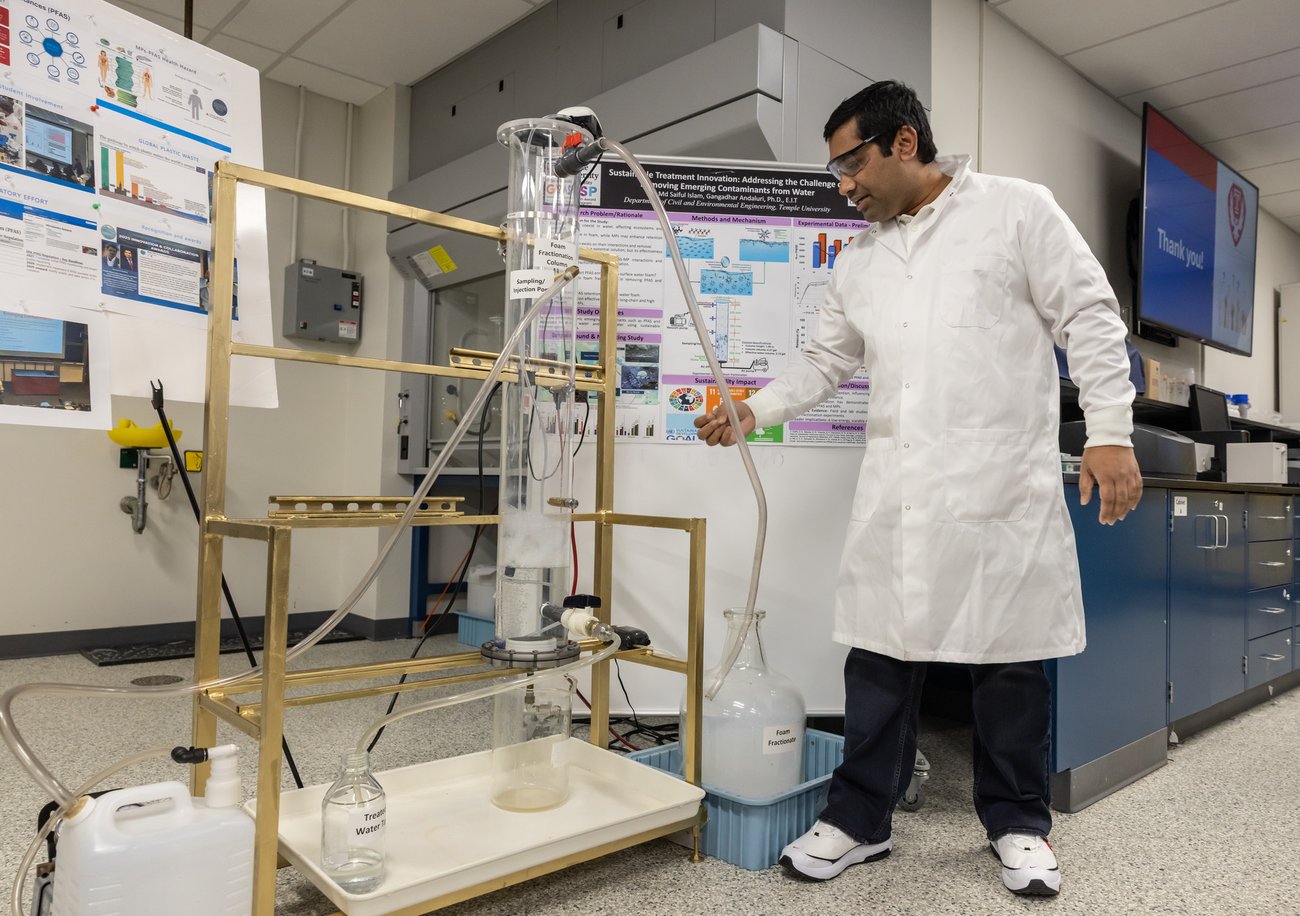
Temple University (Philadelphia, PA) researchers are developing a sustainable, chemical-free treatment process for removing PFAS and microplastics from drinking water using simple air bubbles. This process utilizes air bubbles to create foam that captures contaminants, which can then be easily separated from water. Their work began after observing that PFAS in water samples accumulated in surface foam during sample analysis, leading the team to explore whether this natural foaming behavior could be harnessed intentionally for contaminant removal. Although foam-based treatment is not new, this innovative process can be utilized to remove both PFAS and microplastics, offering water systems a potential solution for future regulatory requirements.
This treatment process, often referred to as foam fractionation, uses rising air bubbles to selectively attract and lift contaminants to the water’s surface. Because PFAS molecules and most microplastics have hydrophobic properties, they readily attach to the bubble surfaces as the bubbles travel upward. This process concentrates both contaminants into a stable foam layer that can be skimmed off, producing only a small volume of concentrated waste (1% of the total filtered water) for further treatment (e.g., supercritical water oxidation). For existing water systems, this process could be integrated at the end of the treatment train, reducing the need for significant modification to the plant. This research aims to provide utilities with a cost-effective and environmentally friendly alternative to existing PFAS and microplastic treatment approaches, which often rely on carbon-intensive filtration or chemical additives and generate secondary waste streams. |
 |
|
Source |
|
|
|
|
|
|
University of Hawaiʻi at Mānoa researchers are collaborating with the University of South Florida on a three‑year, $5 million National Science Foundation project to address the environmental and public health risks from outdated wastewater infrastructure in island communities. Hawaiʻi currently has an estimated 83,000 cesspools that leak 52 million gallons of raw sewage daily, contaminating coastal waters and coral reefs, costing homeowners up to $50,000 per replacement. The team is helping develop and pilot‑test the “Honu Hub,” a compact, solar‑powered, decentralized wastewater treatment system designed to replace cesspools and to overcome local challenges such as poor soils, high water tables, and saltwater intrusion. The goal is to create a solution that can be adopted throughout the U.S. Pacific region and eventually across the country. Pilot testing is currently underway at the Wahiawā Wastewater Treatment Plant, in collaboration with the City and County of Honolulu. |
|
|
|
|
Researchers at the University of Hawaiʻi at Mānoa are exploring how sun-powered organisms, such as microalgae, found in freshwater pools could help fuel Hawaiʻi’s sustainable future by transforming these organisms into sources of biofuels, medicine, and nutrition. The study, which was published in Plant Biotechnology Journal, highlights how synthetic biology and metabolic engineering, using tools like CRISPR/Cas9, can “reprogram” microalgae to produce higher concentrations of valuable lipids (oils) and terpenoids (organic chemicals) without slowing growth, addressing long‑standing barriers to commercial‑scale production. Without cutting-edge synthetic biology and metabolic engineering, producing microalgal products at a scale that can compete with petroleum is difficult.
So why microalgae? Microalgae can naturally capture carbon dioxide and convert it into high‑value compounds, and because they don’t compete with food crops for land or freshwater, they offer a sustainable, scalable resource for island communities. By integrating microalgae production with wastewater treatment or agricultural byproduct recycling, the technology could offer utilities and communities a solution that treats wastewater while producing renewable fuels, reducing dependence on imported fuel. With Hawaiʻi’s year‑round sunshine and coastal access, researchers have an ideal environment for algae cultivation, helping to develop a system that is both environmentally friendly and economically viable.
|
|
|
|
|
Researchers at the University of Oulu in Finland have developed an inexpensive, iron‑modified pine‑bark filtration medium capable of removing a wide range of pharmaceutical residues including antibiotics, antidepressants, painkillers, and blood‑pressure medications from wastewater treatment plant effluent, offering a sustainable alternative to more costly processes such as activated carbon or ozonation. Pine bark’s natural polyphenolic compounds make it easy to chemically modify, and when enhanced with magnetite, the material can be efficiently separated after treatment. Pilot tests at the Taskila wastewater treatment plant showed removal rates of certain pharmaceuticals often exceeding 90%. Because current wastewater treatment technologies do not fully eliminate pharmaceuticals, this sustainable approach offers a low‑cost, circular‑economy solution. |
|
|
|
|
Rural and urban communities are increasingly exploring liquid‑only sewer (LOS) systems as a decentralized wastewater collection approach that separates solids at the source and transports only clarified liquid effluent through small‑diameter, pressurized pipes. In an LOS setup, each property uses a septic or interceptor tank to retain solids, allowing only the liquids to flow into a narrow pipeline network that can be installed at shallow depths and along natural land contours, reducing the need for extensive excavation and lowering capital costs. Because solids stay onsite and the liquid effluent is largely free of solids, LOS networks avoid many blockages common in traditional sewers and minimize inflow and infiltration, offering communities a lower‑cost, less invasive alternative to conventional large‑diameter sewer systems. |
|
Upcoming Events
A listing of webinars, symposia, and conferences relevant to this work. |
|
|
|
Advancing Understanding of Data Center Effluent
February 18, 2026 / Virtual 14:30 - 16:00 Eastern Time Zone
Water Environment Federation
This free webinar will explore the current state of knowledge on data center wastewater effluent and provide clear, practical guidance for utilities and other water professionals. |
|
|
|
Digital Transformation at Columbia
March 5, 2026 / Virtual 11:00 - 12:00 Mountain Time Zone
American Water Works Association
This free webinar will highlight how Columbia Water modernized its utility operations by replacing legacy infrastructure and reallocating existing budget dollars to fund advanced metering and AI‑enabled customer service improvements. |
|
|
|
2026 WateReuse Symposium
March 8-11, 2026 / Los Angeles, CA
WateReuse Association
This annual symposium is the premier conference on water recycling, allowing water professionals and water reuse practitioners globally to share experiences, network, and collaborate. |
|
|
|
|
|
|
|
|
|
|
Wastewater | Open Access
A Novel Soft Sensor Framework Based on Adaptive LSTM Ensemble for Robust Water Quality Prediction in Wastewater Treatment Plants
Chen, S., He, K., Huang, S., Yin, Q., Wong, Y., Ge, Y., & Hao, A. (2026). A novel soft sensor framework based on adaptive LSTM ensemble for robust water quality prediction in wastewater treatment plants. Water Science & Technology, 93(1), 1. https://doi.org/10.2166/wst.2025.171.
Why it's interesting: This study introduces a new predictive soft sensor that helps wastewater treatment plants more accurately forecast influent water quality and better prepare for operational changes. Researchers developed a hybrid long short‑term memory (LSTM) machine‑learning model that uses historical sensor measurements (e.g., COD, TN) to predict future values of these same parameters. Trained on real‑world influent measurements from an urban WWTP, the hybrid model outperformed a standard LSTM, reducing errors and improving prediction accuracy across multiple water‑quality indicators. This predictive soft sensor will help wastewater treatment plants anticipate influent changes so operators can proactively adjust treatment processes, improving efficiency and reducing operational costs. |
|
|
Drinking Water | Not Open Access
Nanoplastics Induce Prophage Activation and Quorum Sensing to Enhance Biofilm Mechanical and Chemical Resilience
Wang, H., Chen, H., Ruan, C., Liao, J., Schwarz, C., Shi, B., Alvarez, P. J. J., & Yu, P. (2026). Nanoplastics induce prophage activation and quorum sensing to enhance biofilm mechanical and chemical resilience. Water Research, 288, 124712. https://doi.org/10.1016/j.watres.2025.124712.
Why it's interesting: This study investigates how nanoplastics found in natural and engineered water systems affect biofilm formation. Biofilms can protect harmful bacteria from disinfectants, making them harder to remove from drinking water. Researchers wanted to understand whether nanoplastics could change how these biofilms grow and behave, particularly by influencing interactions between bacteria and viruses that live within these microbial communities. To simulate these interactions, mixed‑species biofilms of E. coli and Pseudomonas aeruginosa were mixed with two types of polystyrene nanoplastics at levels similar to those already found in the environment. Extracellular polymeric substances (EPS) were then extracted from the biofilms for laboratory analysis.
The study found that nanoplastics significantly stimulated biofilm growth and made them tougher and more resistant to disinfectants commonly used during water treatment. Nanoplastics entered bacterial cells and caused oxidative stress, which in turn activated dormant viruses inside E. coli, destroying the cells, resulting in the release of DNA and proteins that helped biofilms thicken and strengthen. The nanoplastics also promoted the formation of EPS, which is known to make biofilms sturdier. When tested in simulated cast‑iron drinking‑water pipes over several months, nanoplastic exposure led to more resilient biofilm formation, with increased resistance to disinfectants such as chlorine, chloramine, and chlorine dioxide. The study results suggest that nanoplastics may unintentionally make drinking‑water biofilms harder to remove and could complicate efforts to maintain water quality. |
|
|
Wastewater | Open Access
Synergistic Granule-Biofilm PDA Process Enables Ultra-Efficient Nitrogen Removal in Co-Treating High-Strength and Municipal Wastewater
Bai, M., Wang, B., Wang, W., Hao, X., Zou, Y., Xing, Y., Zeng, W., & Peng, Y. (2026). Synergistic granule‑biofilm PDA process enables ultra‑efficient nitrogen removal in co‑treating high‑strength and municipal wastewater. npj Clean Water. https://doi.org/10.1038/s41545-025-00549-0.
Why it's interesting: This report outlines a new two‑stage partial nitrification–partial denitrification–anammox (PN‑PDA) system designed to simultaneously treat high‑strength ammonia wastewater and municipal wastewater with exceptionally high nitrogen removal efficiency. By engineering a synergistic “granule–biofilm” structure inside the reactor, the system achieved stable effluent nitrogen levels of around 5 mg/L over 160 days. Granular sludge served as the primary site for anammox activity, while biofilms excelled at partial denitrification, producing nitrite that the granules then consumed. This combined process results in a resilient, low‑carbon treatment system capable of achieving high nitrogen removal rates without the need for external carbon addition. |
|
|
|
|
|
|
|
|
|
|
|
|
|
|
|
|
|
|
|
WaterOperator.org is a free service, grant-funded to support small community water and wastewater operators with comprehensive resources and information in one easy-to-use place. We also serve the 800+ training, primacy, and technical service organizations, by helping operators get to their information. We aren't selling or advertising anything. Call us at 1-866-522-2681 for assistance. |
|
|
|
|
|
Visit our other websites: |
|
|
|
|
|
|
|
Click here to unsubscribe | Sent to: _t.e.s.t_@example.com
Illinois State Water Survey, 2204 Griffith Drive, Champaign, IL 61820, United States |
|
|
|
|


