DecentralizedWastewater.org Newsletter for January 2026 |
|
|
|
|
|
Attend a NOWRA/RCAP Training Workshop in Spring 2026
|
 |
|
Last year, the National Onsite Wastewater Recycling Association (NOWRA) and the Rural Community Assistance Partnership (RCAP) began jointly hosting a series of professional-focused workshops and train-the-trainer sessions, to educate local professionals and technical assistance providers (TAPs) to be able to offer quality onsite wastewater education within their communities. The trainings fall into three categories: Small Communities, Operations & Maintenance, and Difficult Sites.
After last year's series launch, the partnership is hosting several more workshop events through Spring 2026. The first two events were held this month in Massachusetts and Indianapolis. There are five more workshops currently scheduled through April. Note down these dates if you are in the area to make any of them!
-
March 2-5: Difficult Sites — Ripley, West Virginia
-
March 16-19: Difficult Sites — Griffin, Georgia
-
March 23-27: Decentralized Wastewater System Operations and Maintenance — Springfield, Missouri
-
April 7-9: Resolving Wastewater Treatment Challenges in Small Communities —
Owasso & Tulsa, Oklahoma
-
April 20-24: Operations & Maintenance — Madison, Wisconsin
|
| More Information » |
|
|
|
|
|
|
|
|
Announcing the Private Well Conference 2026 |
|
|
|
Calling anyone whose work also overlaps with private wells!
PrivateWellClass.org, our sister program, has recently announced it will be holding its 2026 Private Well Conference in Missoula, Montana! Join our teams from May 19-21 at Missoula's Holiday Inn Downtown for a unique conference providing information and insights that can be taken home and used to help your local well owners.
The Private Well Conference supports the thousands of professionals who work with wells every day — including health department staff, lab personnel, extension educators, well drillers, EHPs, and researchers. We were thrilled with the success of last year’s conference in Bloomington-Normal, Illinois — the first we hosted in three years — and are very excited to expand into the West this spring.
We'll have more details available in the coming weeks. But our Call for Abstracts is currently open, and we do welcome submissions that touch on septic systems as well. If you have a presentation you'd like to give, especially one that focuses on the overlap between wells and septic systems, we encourage you to submit it!
Find more information on the conference, the Call for Abstracts, and past Private Well Conferences at the Private Well Class website. |
|
|
|
|
The WWETT Show Is Coming Up Fast |
|
|
|
|
|
The 2026 Water & Wastewater Equipment, Treatment & Transport Show is just about a month away — And you still have time to register if you haven't yet! You can attend for as little as $95, for the Expo Only Pass. Opting for the Full Education Package in order to earn CEUs is $355, or $250 for Public Sector/Municipal employees.
Don't miss out! Make your plans to attend sessions, get your credits, network, and visit Indianapolis today.
|
| Register Here » |
|
|
|
|
TT066 – Understanding PFAS and Private Wells (Part 2) |
|
|
![The promotional graphic for Tap Talk episode #66, featuring photos of guests Jackie MacDonald Gibson and Jenny Hoponick Redmon; and a quote: "Every single American should be able to turn on their tap and [have] water that is safe, affordable, and reliable. Bottled water is not a guarantee of that.".](https://content.app-us1.com/cdn-cgi/image/width=650,dpr=2,fit=scale-down,format=auto,onerror=redirect/lmplq/2025/11/05/b4b994e8-1a31-47b7-94fe-9a4ad886d3df.png "The promotional graphic for Tap Talk episode #66, featuring photos of guests Jackie MacDonald Gibson and Jenny Hoponick Redmon; and a quote: \"Every single American should be able to turn on their tap and [have] water that is safe, affordable, and reliable. Bottled water is not a guarantee of that.\".") |
|
In this episode of Tap Talk, we concluded a two-part series exploring PFAS and their impact on private well users. Our conversation with Dr. Jacqueline MacDonald Gibson and Jennifer Hoponick Redmon dives further into their research efforts and its potential applications. Together these episodes offer important foundational understanding as well as new insight on PFAS exposure via well water. |
| 🎧 Listen Here » |
|
|
|
|
|
|
Featured Webinars & Training |
|
|
|
Introduction to Advanced Onsite Wastewater Treatment Systems
January 20 | 1:00 pm ET | Environmental Finance Center Network
This free webinar will introduce the fundamentals of innovative and advanced treatment units. It will explain how these systems work, when they are most effective, and what factors help determine the right technology for a given site. I/A systems offer effective solutions where traditional septic systems fall short, including properties with limited space, challenging soils, or other site constraints. These technologies provide higher levels of treatment, can reduce nutrient loading, and broaden the options available to homeowners and communities.
Register here » |
|
|
|
Decentralized Septic Systems
January 20 | 10:00 am PT | Sparks, NV | RCAC
This four-hour class is designed to provide attendees with valuable information on the operation and maintenance of onsite wastewater systems.
Register here » |
|
|
|
Source Water Protection and OWWS —
Are We Drinking the Same Water as Dinosaurs?
January 21 | 1:00 pm ET | Infiltrator Water Technologies
This free live webinar will discuss the water cycle and how is does not end with wastewater, but is a continual loop. It will be an overview of source water protection and the role properly functioning onsite wastewater systems play in maintaining healthy watersheds.
Register here » |
|
|
|
Basic Pump Systems
February 4 | 9:00 am PT | Orenco Systems
This webinar covers the complexity of wastewater pumping systems, since even "basic" isn't necessarily basic. In this webinar, the different pumping applications and the various parts of a pumping system will be reviewed. Tips for a successful installation will be discussed. This webinar is designed for installers and service providers, but is open to all attendees.
Register here » |
|
Choosing Tanks, Risers, and Lids
February 18 | 9:00 am PT | Orenco Systems
In this webinar, Orenco will discuss why quality tanks, risers, and lids are necessary; and also explain how to use them to help wastewater treatment systems function at peak performance levels.
Register here » |
|
|
|
|
Highlights from Onsite Installer + Pumper Magazines |
|
|
|
Reader Favorites: The Most Popular Articles of 2025
Onsite Installer's most-read articles of 2025 covered topics such as the importance of pumping during evaluations, troubleshooting mound systems, setbacks to trees and roots, leveraging AI, evaluating tanks cracks, and more.
|
| Read Here » |
|
|
|
Pumper’s Top 10 Stories of 2025
At Pumper, the year's most popular stories dove into areas like the dangers of silica dust, cleaning products, the next generation of female trade workers, confined space entries, workforce retention, and more.
|
| Read Here » |
|
|
|
|
|
Six expert tips for a healthy septic system:
What every homeowner should know
Cultivating Curiosity
University of Georgia, College of Agricultural & Environmental Sciences
University of Georgia Cooperative Extension water resource expert Gary Hawkins breaks down the most important things for each septic owner to know in this episode of UGA's Cultivating Curiosity podcast. He explains the science of septic systems, how to keep them working properly, and how doing so will protect well water and prevent costly repairs.
|
| Listen Here » |
|
|
|
|
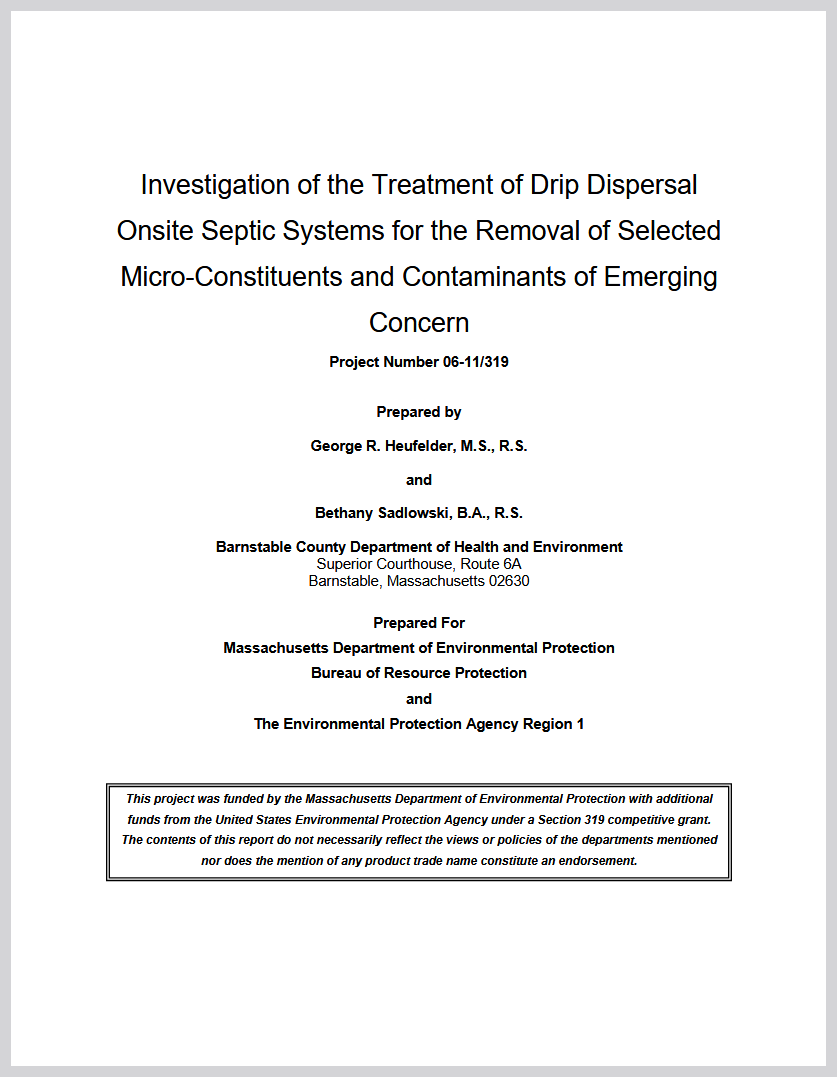
| Investigation of the Treatment of Drip Dispersal Onsite Septic Systems for the Removal of Selected Micro-Constituents and Contaminants of Emerging Concern
This 47-page paper, produced for the Massachusetts Dept. of Environmental Protection and the US EPA Region 1, examines how drip dispersal onsite septic systems remove pharmaceuticals, hormones, and other contaminants of emerging concern from wastewater. Removal rates often approach 100%. It highlights an effective, soils-based treatment method that may outperform some municipal systems, offering insights into sustainable wastewater management and public health protection.
|
| Read Here » |
|
|
|
|
|
|
|
Visit our other websites: |
|
|
|
|
|
|
|
Click here to unsubscribe | Sent to: _t.e.s.t_@example.com
Illinois State Water Survey, 2204 Griffith Drive, Champaign, IL 61820, United States |
|
|